


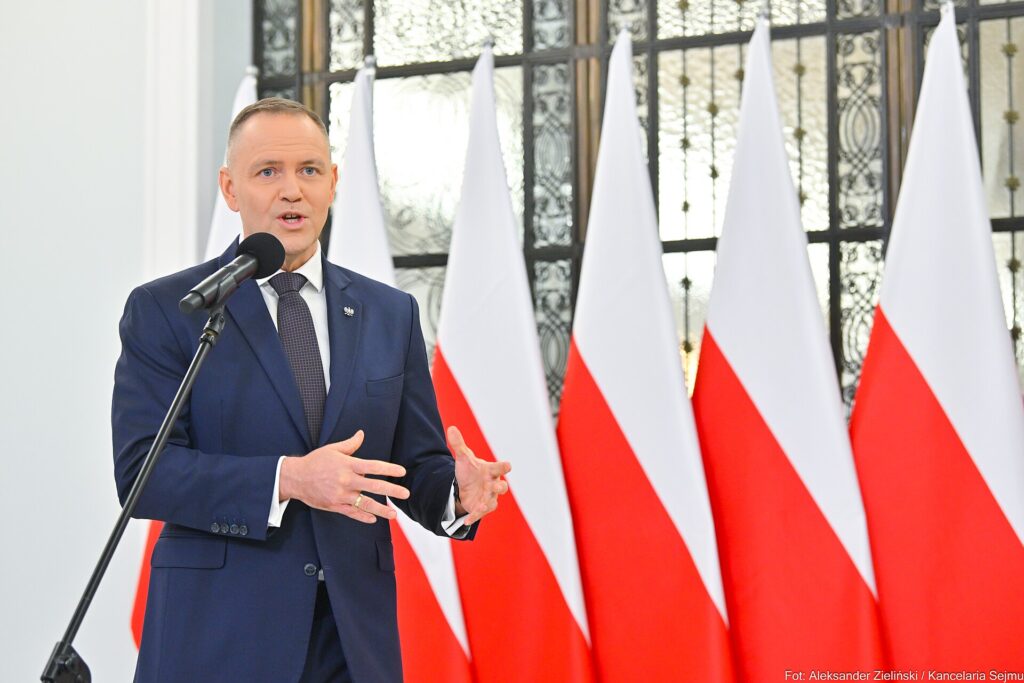
Karol Nawrocki – the President of the Republic of Poland who, according to the narrative of the government led by Donald Tusk, „does nothing but veto legislation,” has signed 245 bills into law since his inauguration! That means he approves six out of every seven that land on his desk. If this is sabotage, as the public is being told to believe, it is remarkably inept sabotage. And what if the problem lies not with the president, but with the quality of the Polish parliament’s legislation?
When George Westinghouse patented the railway air brake in 1869, the magnate Cornelius Vanderbilt is said to have brushed the inventor off, declaring that he had no time to waste on fools. The railways of the day advertised themselves by the speeds they reached, while braking looked like this: brakemen scrambled across the roofs of speeding carriages, tightening hand cranks. They died by the hundreds. It was only Westinghouse’s brake that allowed trains to run truly fast — precisely because they knew how to stop. The Anglo-Saxons deliberately named the foundation of their political system „checks and balances” — brakes and counterweights. A brake is not the enemy of the journey. It is the very condition of reaching your destination.
Table of Contents
The Arithmetic of the „Veto Machine”
It is worth keeping this in mind whenever we hear the tale of President Karol Nawrocki — the „veto machine” who supposedly blocks everything the Polish parliament passes. Robert Biedroń announced that the president had „vetoed a record number of bills” in order to „trip up this government.” Yet the numbers are merciless to that thesis. As of July 23, the president had signed 245 bills, vetoed 41, and referred a handful to the Constitutional Tribunal. More than 85 percent of the legislation passed by the coalition majority entered into force bearing the president’s signature — despite, as he himself emphasizes, his „highly critical assessment of the competence and policies of the current government.” „Some people have a problem with mathematics and statistics when they call me a veto machine,” Karol Nawrocki remarked in his anniversary address. It would be hard to find a more accurate diagnosis.
An Exam in Legislation
Various comparisons have already been tried. Closer to the truth, however, is the figure of the driving-test examiner. When one candidate in seven fails, no reasonable person claims the examiner „flunks everyone.” We ask, rather, why the driving school keeps sending unprepared students onto the practice course. Because a law that enters into force is like a driver on a public road: it can run over every one of us. The President’s Chancellery, for that matter, cites cases in which vetoed bills returned to the Sejm, were corrected, and were then signed — a veto does not end the legislative process, it corrects it. This is not political emotion. The president’s veto is quality control — the final inspection before the factory gate.
A Notary on Krakowskie Przedmieście?
The pressure on President Karol Nawrocki to sign everything the parliamentary majority passes is enormous today, and it is exerted entirely in the open. Yet a president reduced to the role of a notary („I am not the government’s notary,” Karol Nawrocki reminds us) ceases to be needed at all. Article 126 of the Constitution states that the president safeguards its observance; if the signature were an automatic act, a rubber stamp and a duty clerk would suffice. Without a real decision by the head of state — signature, veto, or referral to the Tribunal — we would have a system in which anything an ad hoc majority votes through becomes law that very same evening. It is also worth remembering that the presidency is the only office in the state filled directly by the votes of all Poles. The veto, then, is not the whim of an individual pitted against democracy — it is the voice of the second, most democratic source of legitimacy. Those who today demand a president-automaton should give some thought to the day when they themselves end up in the minority.
The Thermometer and the Fever
The number of vetoes is a thermometer measuring the quality of parliamentary legislation — and you do not smash the thermometer to bring down the fever. If one bill in seven was unfit for signature, it means one in seven was poorly prepared — slapdash work, dashed off to political order. The very existence of a real veto, moreover, works like a goalkeeper on the pitch: the striker takes better aim when the goal is not standing empty. How many legislative duds were never written at all, simply because the government knows that at the end of the process someone actually reads the bills — and understands them?
The railways that ridiculed George Westinghouse went on, years later, to make his brake a mandatory standard, because passengers stopped boarding trains that could not stop. So the question today is not whether the president brakes too often. The question is: who among us would board a train whose brakes had been removed for the engine driver’s convenience?
Miłosz Manasterski
Soruce AI Opinie / Miłosz Manasterski / Photo: President RP Karol Nawrocki – by Aleksander Zieliński, Sejm RP, Wikimedia / 29.07.2026