


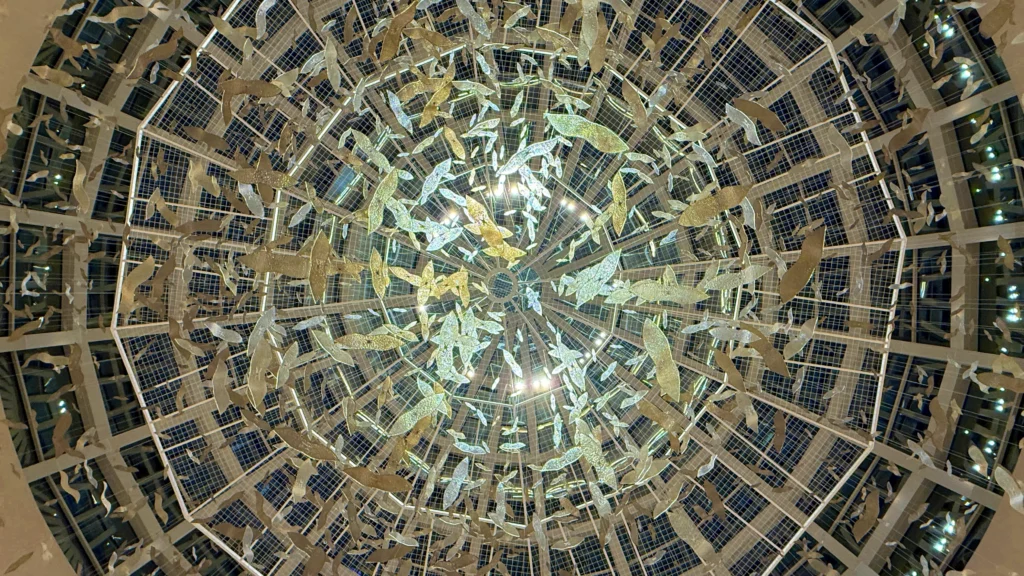
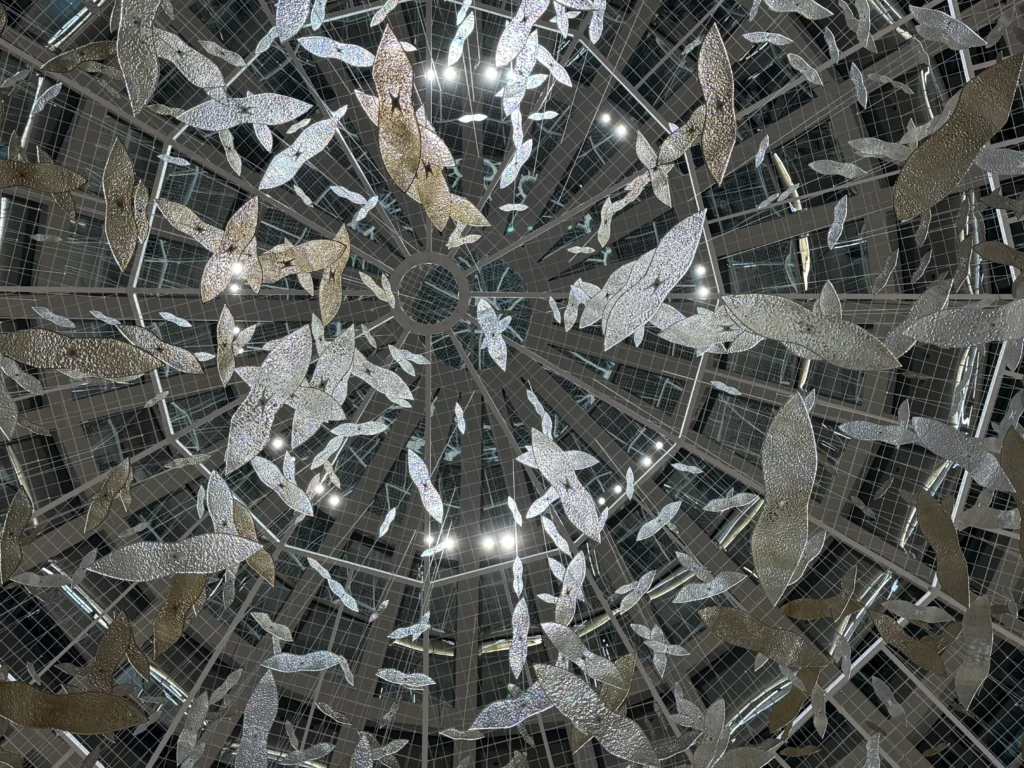
Polish NEWS: Beneath the glass dome of The District at Dubai Mall hovers “Cloud of Birds” — a spectacular installation by Polish artist Edyta Barańska and one of the largest glass artworks in Dubai. Hundreds of fused-glass forms, responding to light and air currents, create a hypnotic dance that draws crowds and taps into Arab symbolism of freedom, strength, and prestige.
Table of Contents

At the heart of The District: an installation that captures eyes—and audiences
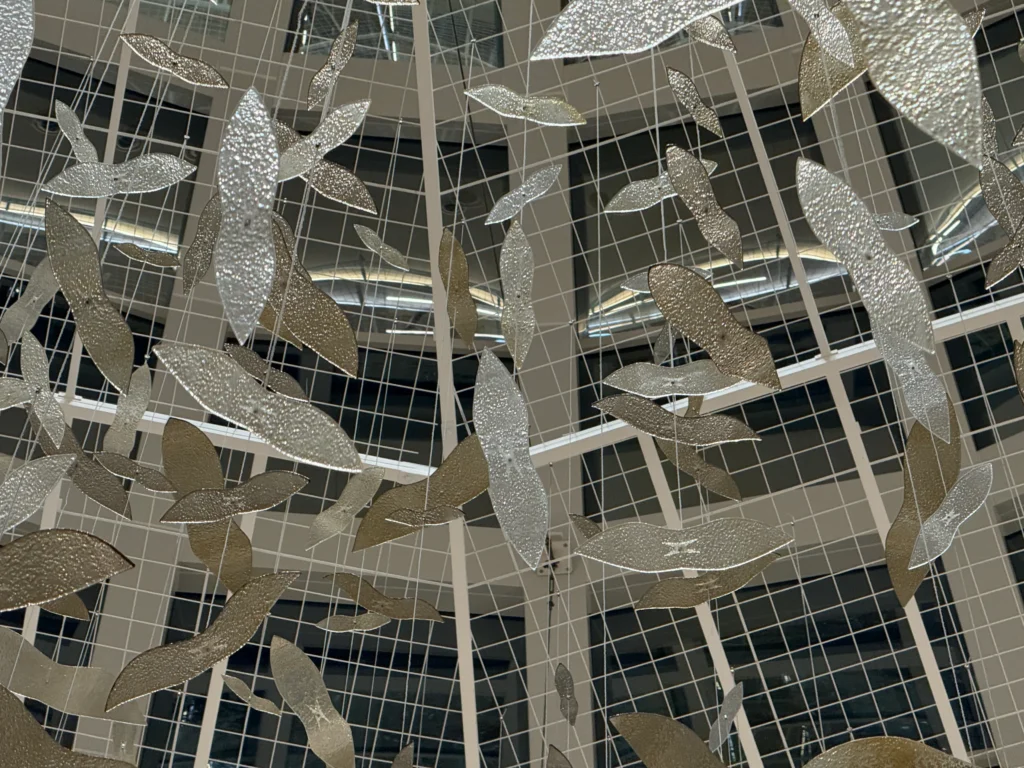
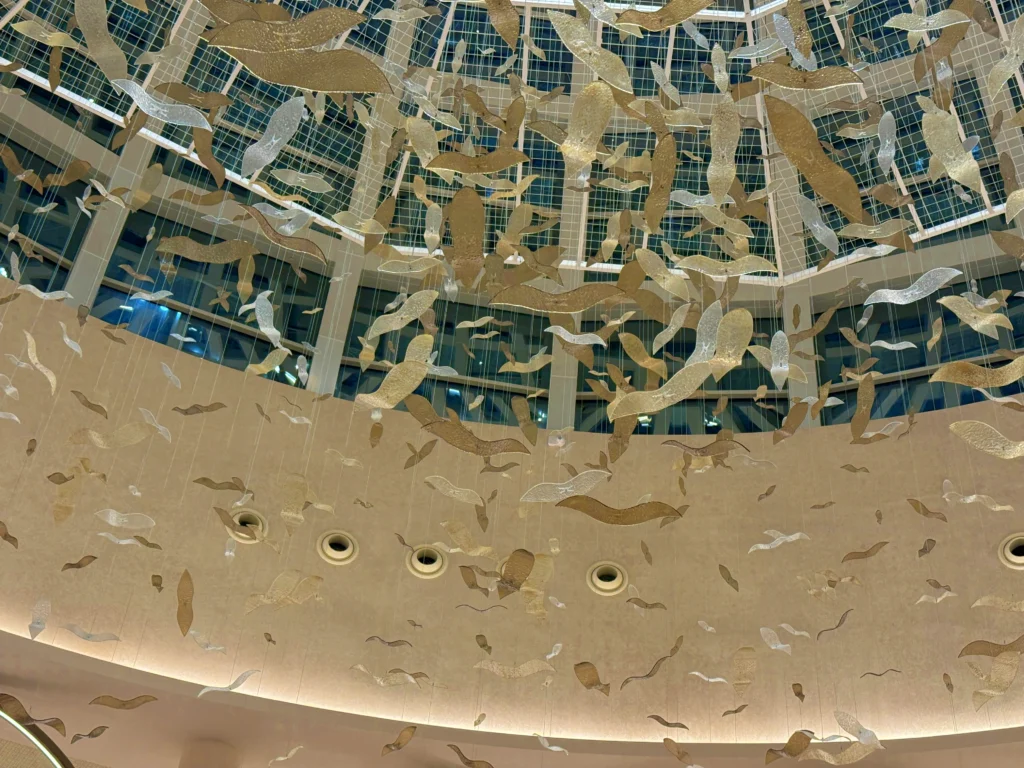
Suspended beneath the glazed dome of The District in Dubai Mall—one of the world’s most prestigious retail spaces—hangs “Cloud of Birds” by Edyta Barańska, created at the Barańska Design studio. It is composed of hundreds of glass forms above visitors’ heads, reacting to light and air to become a “living” sculpture of monumental lightness. As D5 Magazine wrote: “A shimmering cloud of fused glass birds now floats beneath the dome of Dubai Mall’s reimagined District.” LABEL Magazine emphasizes that The District’s dome—the focal point of this revitalized area—was conceived as a “boutique” space where a “light, shimmering cloud of glass birds” converses with a subtle scenography and luxury boutiques, fitting a local rather than a generic, “global” code of luxury. Interest in the installation has not faded since the first publications at the turn of June and July 2025: architecture and lifestyle media across the UAE region have covered the work extensively—including Amazing Architecture, WhiteMad, D5 Magazine, Polisz Design, and LABEL Magazine—documenting its scale, architectural context, and public reception.
Project origins: from a Dubai collaboration to the winning concept
The story of “Cloud of Birds” began several years ago through collaboration with Art in Public Space, a company integrating art into public venues in Dubai. When developer Emaar Properties launched the refurbishment of The District’s dome, international studios were invited to submit proposals. As the portal Amazing Architecture reported, this was when Barańska proposed delicate, organic forms in kiln-formed glass, prepared prototypes, and—after the owner’s approval—entered a meticulous design and engineering process to create a monumental installation that would remain in harmony with the architecture and the sightline toward Burj Khalifa. Polisz Design cites the artist in a way that captures the “birth” of the idea: “We proposed fused glass in delicate, organic forms reminiscent of birds”—a solution that prevailed over competing proposals and became the foundation for a project that has since become one of the region’s most recognizable realizations. As D5 Magazine noted, the final composition “had to ‘fly’ evenly beneath the dome,” preserving calm and order while subtly guiding the gaze toward Burj Khalifa, the visual axis that structures how visitors experience the mall.
Fusing technique and the dramaturgy of light: how glass begins to “live”
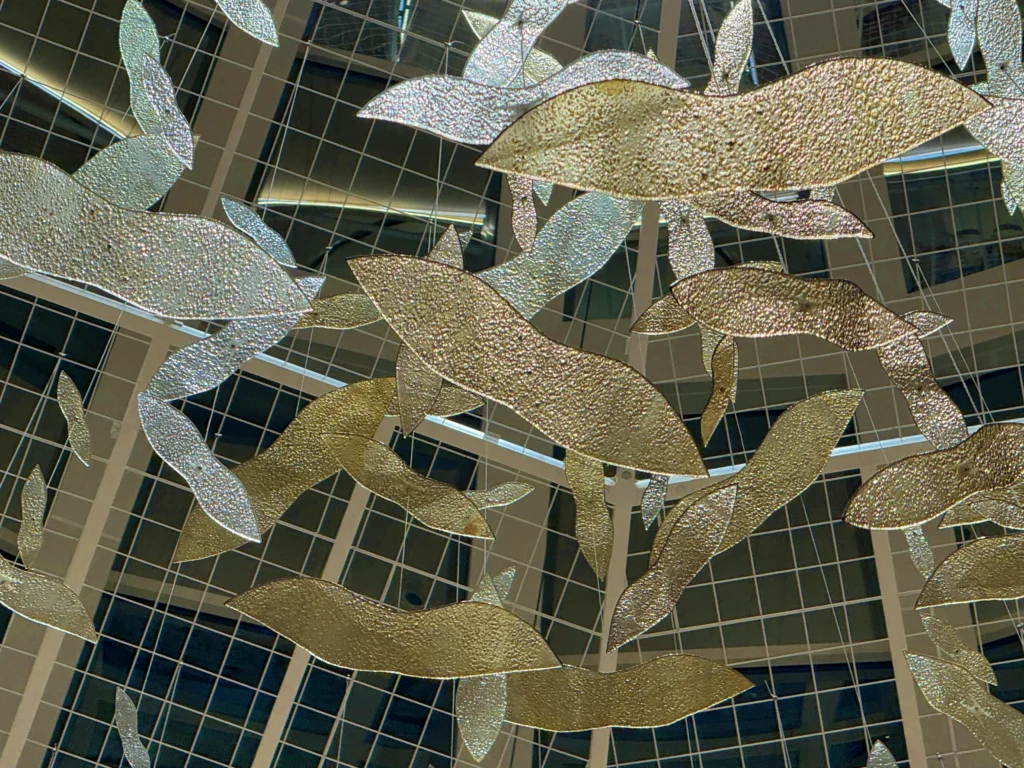
What makes “Cloud of Birds” exceptional is both material and method. WhiteMad underscores that the heart of the piece is fusing—controlled softening of glass at high temperature over open molds, a process that enables precise modeling of wing textures and edges while maintaining their airiness and transparency. As the portal explained: “It is a process in which glass falls onto a pre-prepared mould,” which means the mold must remain “open” so the element can be removed after firing—an essential constraint of the technology. Thanks to this approach, the glass “lives” in light—reflecting, refracting, and filtering it. In the morning, especially between 10:00 and 12:00, when the sun strikes at the ideal angle, the rippled texture and depth of color emerge; after dusk, under discreet lighting, the composition becomes a spectacle of golden highlights and shadows—an effect repeatedly described by LABEL Magazine and Polisz Design. D5 Magazine adds that the birds—created in several scales—respond subtly to shifts in illumination and color temperature, ensuring that every encounter with the installation is slightly different. It’s a unique dramaturgy of light and material that fuses sculpture, architecture, and the site’s scenography into a single visual experience.
A dialogue with architecture and the meaning of birds in Arab culture
“Cloud of Birds” is also a story about anchoring a motif in local tradition. As Amazing Architecture wrote: “In Arab culture, birds—alongside horses—hold deep symbolic meaning,” representing freedom, prestige, and strength, and appearing frequently in the region’s iconography, from emblems to interior details in offices and homes. The choice of subject is therefore not a formal whim, but a conscious gesture toward the Arab imaginary: a delicate, organized cloud of birds is meant to evoke calm and lightness while “carrying” the dome’s monumental scale and activating the sightline toward the world’s tallest tower—a point widely discussed by D5 Magazine and Polisz Design, which stress that the installation was meant not to dominate the space but to complete it and discreetly structure visitors’ impressions. This is why—Amazing Architecture further reported—one of the key design requirements was perfectly balancing each element so the “birds” remained level and “flew” evenly beneath the dome. The result is a poetic manifesto of values embedded in Dubai Mall’s narrative: luxury, strength, and freedom—at once local and universal.
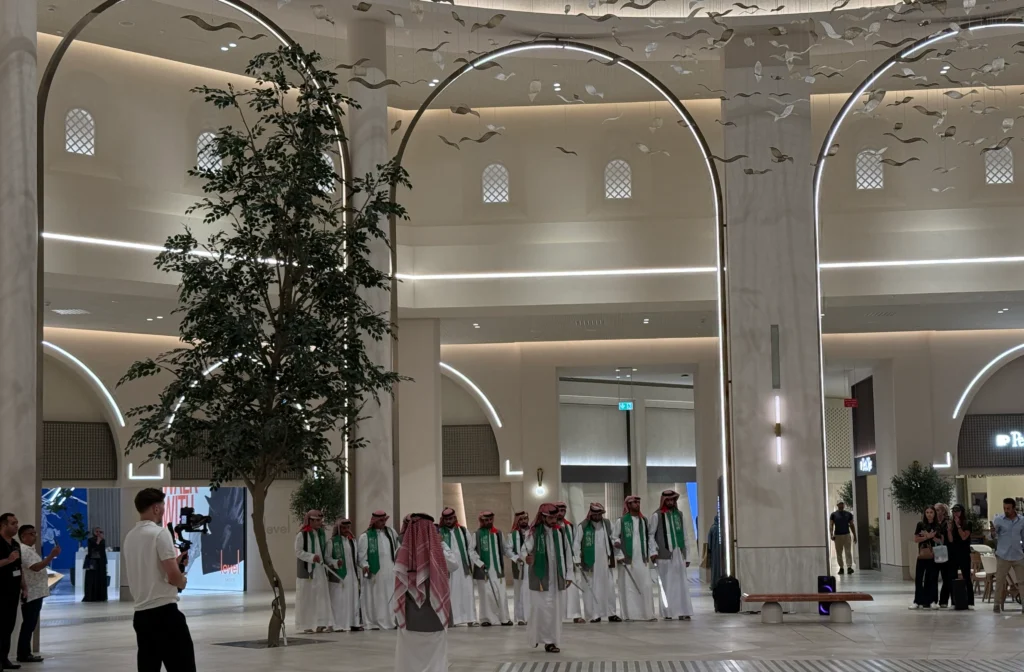
A testament to how strongly the project is rooted in Arab culture is the way the space beneath it is used today. It has become a venue for celebrating events tied to regional culture and tradition—for instance, traditional dance performances are held there.

Reception and lasting interest: a “kinetic” cloud people return to
One of the most fascinating byproducts—and secrets of the installation’s popularity—turned out to be the movement created by airflow under the dome. As LABEL Magazine wrote, the dome “creates a vortex that sets the birds into a subtle, almost organic motion,” and it is this gentle, hypnotic dance that makes visitors stop, photograph, and return to see the installation at different times of day. D5 Magazine adds that initial concerns about air conditioning paradoxically turned the project into a “kinetic” work—“they had to ‘fly’ evenly beneath the dome,” yet the delicate eddy bestowed an aura of non-literal flight that cannot be fully predicted, only experienced in person. WhiteMad, for its part, details how the chosen technology and glass texture amplify this effect of “coming alive” in light and shadow—naturally sparking curiosity and fueling media and public interest. It is no coincidence, then—as repeatedly emphasized by Amazing Architecture and Polisz Design—that the project is interpreted not only as an impressive sculptural realization but also as a coherent element of public-space programming that redefines the shopping and tourist experience at Dubai Mall, drawing visitors and opinion-forming outlets well beyond its debut, throughout the following weeks of summer 2025.
Polish NEWS, Culture / Source: Agencja Informacyjna /