


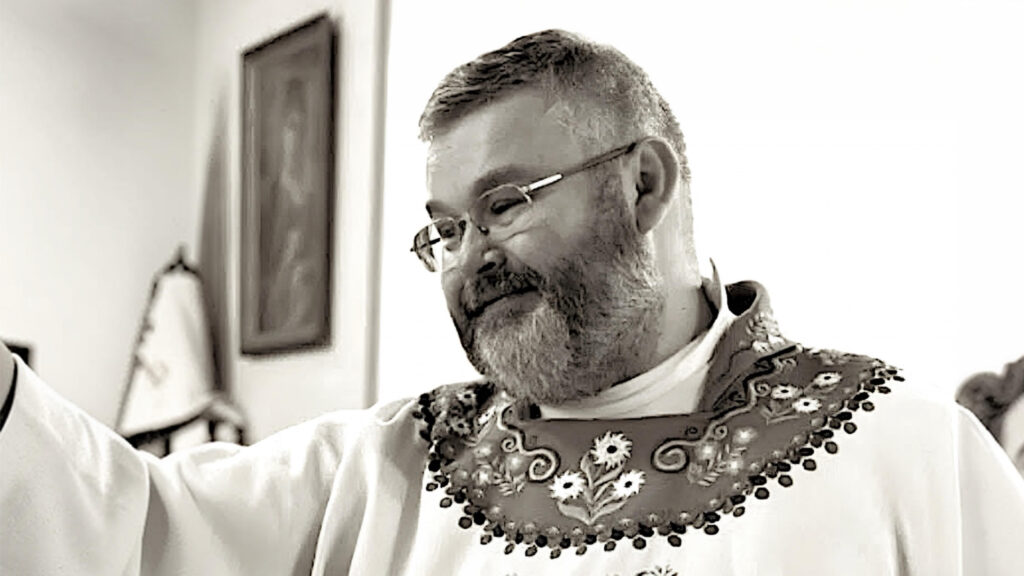
Fr Wojciech Drab, parish priest of St Barbara’s Church in Wałbrzych and an exorcist of the Diocese of Świdnica in south-western Poland, died in a motorcycle accident on September 21, 2026, while travelling to a meeting of exorcists. Five days earlier, he had published one of his final reflections. In it, he spoke about friendship, human relationships and a bond which, he said, can be “stronger than death.”
There is no reason to suggest that Fr Wojciech Drab foresaw his own death.
Yet after the fatal accident, one of his final public reflections has acquired an unexpected resonance.
On September 16, while reflecting on the early Christian saints Cornelius and Cyprian, Fr Drab began by speaking about friendship.
Table of Contents
Cornelius lived in Rome and Cyprian in Carthage. Fr Drab noted that in the third century they were separated by a considerable physical distance, yet maintained a close friendship and supported one another.
“They supported each other greatly, even though they lived quite far apart, because one was in Rome and the other in Carthage. And in their time it was not so easy to travel from Rome to Carthage or the other way around. And yet they were bound by a great friendship and gave each other great support.”
He then moved from the story of the two clerics to a broader reflection on human relationships.
“I think this is what we are invited to: to be together. And it turns out that this togetherness, this inner togetherness, is stronger than distance, stronger than time, even stronger than death. (…) Ultimately, this is what matters: that we are together.”
Five days later, the 54-year-old priest was dead.
An Exorcist Who Spoke About Relationships, Not Demons
The circumstances of Fr Drab’s death are striking because of the role he had held since 2015.
He was one of the exorcists of the Diocese of Świdnica. On September 21, he was travelling by motorcycle to a meeting of exorcists when he was killed in a road accident.
Yet his online reflections show that his regular teaching was not primarily about extraordinary spiritual phenomena.
Instead, he often spoke about human relationships, self-worth, frustration, expectations and the way people perceive themselves and others.
In his September 16 reflection, Fr Drab discussed the Gospel image of people who remain dissatisfied regardless of what happens around them.
He compared it to a person who expects other people, and eventually the entire world, to adjust to his or her expectations.
“We are constantly focused on the idea that everything should adjust to me. Everything should be arranged around me. Another person should do everything exactly as I have imagined it. And later I am disappointed, resentful, devastated because they did not guess what I had in mind, because they did not do it the way I wanted.”
According to Fr Drab, this attitude can gradually destroy relationships.
“Another person irritates me more and more because they are not the way I want them to be. I irritate myself because I do not meet my own expectations. The world irritates me. (…) If something does not correspond to my appetites, my desires, my expectations, my ideas, then I become more and more tense, more and more angry and increasingly resentful.”
“He Had Forgotten Who He Was”
A large part of the reflection concerned identity.
Referring to the biblical parable of the prodigal son, Fr Drab focused on the older brother, who remains with his father but becomes convinced that he has been treated unfairly.
In Fr Drab’s interpretation, his problem was not simply jealousy.
“The problem with the older son is that he has forgotten who he is, or perhaps he has never truly discovered who he is, who the father really is, who he is to the father and what kind of relationship with the father he has been invited into.”
The priest argued that a person can become so focused on obtaining something that he fails to recognise the relationships and gifts already present in his life.
“The older son is focused only on something, because he wants something. He does everything in order to receive that thing. (…) And he becomes increasingly resentful towards his father: I keep doing all this, and I still do not have it. Later, however, the father shows him that everything is already his.”
Fr Drab then formulated one of the central ideas of the reflection:
“What matters most is that God made me someone. I am not something, like the rest of creation. I am someone.”
Although rooted in Christian theology, much of the reflection dealt with a more universal question: whether human beings build their sense of worth primarily through comparison, achievement and the approval of others.
“The First Thing He Says Is: Child”
Fr Drab paid particular attention to a single word.
Recalling the father who goes out to meet the resentful older son, he noted that the father’s first response is not accusation.
“The first thing he says to his son, the first thing he has to say, is: child. Child. The father comes out and the first thing he says is: child.”
He interpreted another Gospel passage in a similar way, in which Jesus compares the people of his generation to capricious children.
“The first thing is not that we are capricious. Yes, we are, Jesus says so and does not hide it. But the first thing is: children.”
He continued:
“Whatever has happened to us, whatever has happened within us, however capricious and petty we have become, however much everything has become confused and however lost we ourselves have become, the first thing He has to say to us is precisely this: child.”
The reflection repeatedly returns to the image of a father lifting up a child.
Fr Drab referred to the Greek word airo, explaining it as “to lift” or “to raise.”
“That gesture of airo was the gesture of a father who took a child after birth and lifted the child up as a sign of acknowledging fatherhood, as a gesture of pride: this is my child.”
For Fr Drab, the image expressed the value of the human person.
“The experience that I am someone, not something, but someone, that I am a person, is constantly the experience of those arms of the Father.”
Fr Wojciech Drab’s Final Days
Only days before his death, Fr Wojciech Drab had continued his pastoral work and online reflections.
He was also known as a motorcyclist and was associated with the God’s Guards, a Polish motorcycle club for Catholic priests.
On September 21, 2026, he was travelling by motorcycle to a gathering of exorcists when he died in a road accident near Strzelce Opolskie in southern Poland.
The circumstances created a striking and tragic fact: a diocesan exorcist died while travelling to a meeting of exorcists.
Fr Wojciech Drab was born in 1971 and was ordained a priest on May 25, 2002.
Since 2015, he had served as an exorcist in the Diocese of Świdnica. From 2018 to 2025, he was parish priest at St Nicholas Parish in Doboszowice. In 2025, he became parish priest of St Barbara’s Parish in Wałbrzych.
He regularly published Gospel reflections and homilies online.
One of his final reflections began with the friendship of two men separated by a great distance and ended with a prayer.
Between those two points came a sentence that, after September 21, acquired a meaning he could not have intended:
“This togetherness is stronger than distance, stronger than time, even stronger than death.”
Polish NEWS / ERR / Source: Agencja Informacyjna / 22.09.2026